
Ibn al-Haytham is often introduced with sweeping titles: the father of optics, the inventor of the scientific method or the first true scientist. Those descriptions are memorable, but history becomes more useful when we resist turning a real scholar into a slogan.
Born in Basra around 965 CE and active for much of his later life in Cairo, Ibn al-Haytham inherited questions studied by Greek and earlier Arabic-writing thinkers. His achievement was not that nobody had investigated light before him. It was the depth with which he brought physical observation, geometry and reasoning together in his seven-book Kitāb al-Manāẓir, usually called the Book of Optics.
A question about sight
One major problem concerned how seeing happens. Some influential earlier theories treated vision as if rays went out from the eye towards objects. Ibn al-Haytham developed a different account: light from luminous sources reaches objects, and light reflected from those objects then enters the eye.
This was more than a clever opinion. He examined light, colour, reflection, the anatomy of the eye and the conditions under which perception can mislead us. His account was not identical to modern optical science, but it marked a major reorganisation of the subject.
Observation must answer the argument
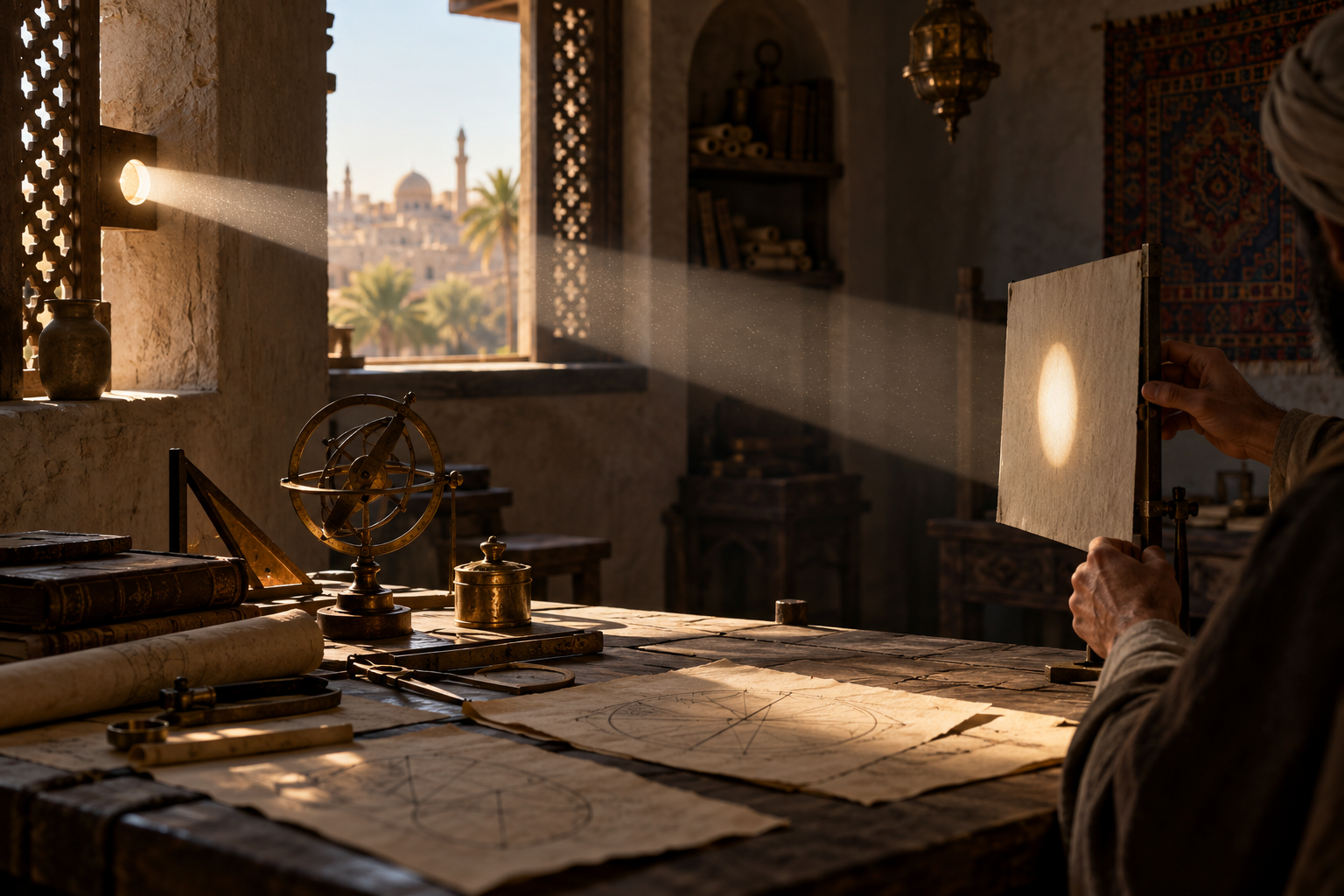
Ibn al-Haytham’s optics repeatedly joined mathematical demonstration to controlled observation. In dark-room investigations, for example, light passing through a small opening produced an observable image or patch of light. Such arrangements allowed claims about straight-line propagation and image formation to be examined rather than merely asserted.
It is safer to say that he developed and used camera-obscura-type observations than to claim that he single-handedly invented the modern camera. A dark room, an aperture and a screen are not yet photography. Their importance lies in making a difficult question visible and testable.
Doubt without carelessness
Ibn al-Haytham also criticised parts of the astronomical and optical traditions he received, including ideas associated with Ptolemy. But disciplined doubt is not the same as rejecting everything old. He studied earlier authorities closely, kept what could be defended, challenged what appeared inconsistent and built a fuller account.
That balance matters today. Credulity accepts a claim because a respected person said it. Cynicism rejects a claim because authority is imperfect. Serious learning asks what the claim means, what evidence supports it, what assumptions it uses and what would count against it.
What responsible history should claim
Modern historians caution against presenting scientific knowledge as the achievement of one isolated civilisation or one heroic individual. Ibn al-Haytham worked within a long conversation involving translation, criticism and development across languages and regions. His optical writings later circulated in Latin and became important within medieval and early-modern European traditions of vision and perspective.
Giving that wider context does not reduce his achievement. It makes it more credible. We can celebrate a Muslim scholar without inventing a miracle claim, erasing his predecessors or pretending that every modern device appeared fully formed in the eleventh century.
A practical family reflection: test before repeating
The Qur’an instructs believers not to pursue what they have no knowledge of and reminds us that hearing, sight and heart are accountable (Qur’an 17:36). This verse is an ethical instruction, not a claim that the Qur’an teaches a modern laboratory procedure. Still, it gives Muslim families a powerful habit: do not confidently repeat what you have not responsibly checked.
Try a simple exercise at home. Choose one surprising claim from a message or video. Ask together: Who first made it? Is the source identifiable? Can another reliable source confirm it? Does the evidence support the exact wording, or only a smaller claim? For a safe optics activity, use a torch—not the sun or a laser—and a piece of card with a small opening to observe how narrowing an aperture changes the light on a wall. An adult should supervise children.
Curiosity joined to humility
The enduring lesson is not that a Muslim scholar solved every question about vision. It is that intellectual courage includes the willingness to slow down, look again and let evidence correct a cherished explanation.
In family life, work, religious learning and public conversation, that habit protects people from rumours and exaggerated claims. Curiosity asks the question. Method gives the question discipline. Humility allows the answer to change us.
Join the conversation
Comments (0)
Start the conversation.