
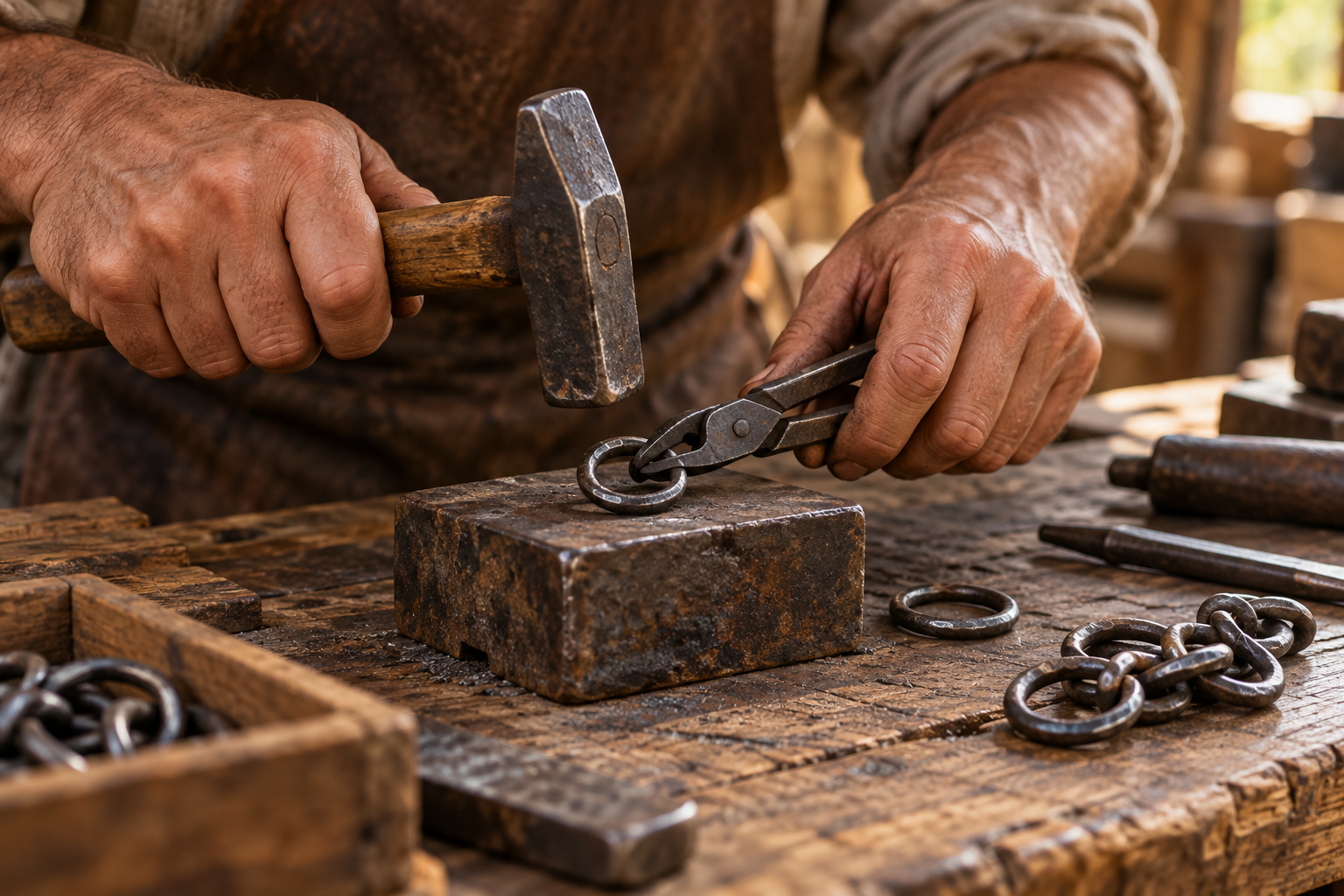
Faith expressed through skill
The Qur’an says Allah made iron pliable for Dawud and instructed him to make coats of mail with precisely measured links. It then calls for righteous action. In another verse, the Qur’an says Dawud was taught to make armour that protected people and asks whether they will be grateful. These verses describe a craft, its care, and its benefit to others.
The dignity of honest labour
The Prophet Muhammad ﷺ also spoke of Dawud’s livelihood. In Sahih al-Bukhari 2072, he says that Dawud ate from what he earned through the work of his own hands. The report gives dignity to honest labour, including work that demands patient practice.
Lessons for everyday work
What might a family take from this account today? One lesson is to value useful skills without looking down on the people who practise them. Another is to take care over the quality of what we provide. Dawud’s armour had to protect its wearer; the instruction to measure its links precisely reminds us that care in our work can matter to someone else’s wellbeing. These are practical reflections on the verses, rather than promises that a particular trade will succeed.
A conversation for the family
A useful conversation at home could begin with three questions: What can I already do well? What skill could I improve with training or practice? Who would benefit if I did that work reliably? For one person, the answer may involve a profession. For another, it may be a craft, a service, or a small business. Families can encourage one another to learn, agree honestly on what they can deliver, and respect the effort behind lawful earnings.
Gratitude in action
The story of Dawud (AS) gives us a picture of faith alongside purposeful, careful work. It also leaves us with the Qur’an’s question about gratitude: how will we use the abilities we have been given?
Join the conversation
Comments (0)
Start the conversation.